
Download

Print



In 2012, HSBC — one of the world’s largest global banks — paid $1.256 billion in regulatory fines. This was on the heels of a broad scale operational transformation. HSBC’s goal: strengthening the bottom line. Their outcome: one of the biggest compliance fines in history. Charged with anti-money laundering and sanctions violations, HSBC admitted to significant operational deficiencies and, as a result, made the risks of ineffective processes abundantly clear.[1]
Most operational transformation attempts won’t result in such steep losses. But most will fail to get things right. As Bain & Company found, few transformational efforts meet their goals.[2] And within the space of operations — where any significant step toward transformation must drive to the core of the way work is done — this isn’t too surprising.
True operational innovation is rare. It requires fundamental change in how work is done. Yet when it comes to operational efforts, what is typically top of mind is efficiency and excellence. In short: improvement. Such improvement can certainly yield positive results, bolstering the balance sheet and, in turn, shareholder value. But improvement alone falls short of the innovation successful transformation requires. As Mankins and Litre put it, “True transformation calls for breakthrough thinking and pushing beyond current practices.”[3]
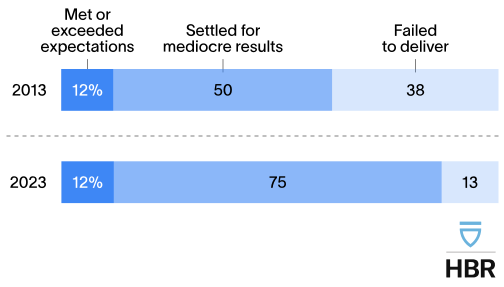
The catch, as Michael Hammer notes, is that many corporate structures make it difficult to marshal breakthrough thinking and move beyond operational improvement. This is for three reasons: (1) the upside of operational change is seen as limited, (2) leadership has no visibility into the mechanics of the organization’s operations, and (3) no one owns operational innovation, strictly speaking, across the organization.[4]
In the C-suite, M&A and other macro growth strategy efforts win the day. In the lower ranks, the value of operational change might be well understood, but the scope of that understanding is siloed within departments. And at all management levels, a clear view of operational mechanics appears elusive. In fact, recent research found that Fortune 500 managers, on average, have reliable visibility into only 40% of the work their teams do.[5]
The prerequisites for operational transformation, then, are clear: visibility and coordination. Without a clear view into the mechanics of an organization’s operations — the full breadth of the what, why, and how — recognizing the uncapped upside of operational innovation and funding a team to capitalize on that opportunity is unlikely, let alone mitigating deep operational risk. Without a mechanism for coordination, operational change remains constrained by the matrixed landscape of the organization itself.
Of course, easier said than done. In principle, spin up a cross-departmental working group, build an end-to-end picture of operational mechanics, and deliver that picture to leadership and the organization at large. In practice, business as usual consumes bandwidth.
In effect, the prerequisites for operational transformation require a specialized team, a task force charged with building the end-to-end picture. Some organizations have project-based teams to deploy for such efforts, internal consulting teams of sorts. Most don’t. The reality, then, is that true operational transformation is either out of reach or outsourced to consultants. At ZENDA, we have been brought in many times precisely for this reason. But we see the future unfolding differently.
Putting operational transformation within reach, with less dependency on capital expenditure, requires a stronger toolkit. The friction in creating an end-to-end map of the enterprise must be reduced.
On the face of things, advances in process mining seem to be the answer. Leveraging data from enterprise-system log files, process mining technology pieces together the processes in place across the organization. Some AI-powered process mining tools can even identify improvement opportunities within system logs and alter enterprise processes accordingly.
PepsiCo is an example of one company who has used process mining to great success. Using Celonis, they have seen upwards of 26% efficiency improvements in their order-to-cash processes.[6]
But PepsiCo’s very success highlights process mining’s limitations. There are three. First, while the best process mining tools can mobilize operational improvements, they can’t, in themselves, mobilize transformation. Breakthrough thinking tailored to a particular organization is a bigger lift.
Second, process mining tools are only as good as the data they’re given. “Garbage in, garbage out,” as they say. For many companies, data beyond the scope of production and payments is insufficient for process mining tools to pull together an end-to-end picture. This applies even if the tool is powered by AI.
Third, process mining tools can’t discover what activities take place beyond enterprise-system log files. Setting the issue of poor data aside, many operational activities occur “off book,” so to speak. From handwritten notes to hallway conversations, many activities that make businesses run simply don’t show up in the data, good or bad. In fact, from SMBs to Fortune 50s, it’s in human workarounds that ZENDA has often found the largest opportunities for operational transformation. And just as this data is hidden to process mining, it’s equally hidden to AI.
For companies with quality systems data in place across the enterprise, process mining is a strong step in providing the visibility required for operational transformation. For companies without quality data, process mining is a nonstarter. In either case, process mining can’t do the job on its own.
What’s needed is a means for filling gaps in enterprise logs, from tracking disparate data passed among siloed systems to capturing the human aspects of processes that live undocumented. Only with these gaps filled can an organization have clear vision into the mechanics of its operations. Only with these gaps filled can an organization overcome the barriers to true transformation and operational advantage.
We’ve often seen organizations attempt to fill these gaps with surveys. From quarterly pulses to software intercepts, employee feedback is solicited in an effort to build a better picture and position for change. The intention is in the right place, as is the direction. But the solution is incomplete.
Survey data is valuable. At minimum, it provides a window into the employee experience, and attending to employee experience is another driver for growth.[7] But there’s no straightforward means to tether survey responses tightly to operations, let alone leverage them to build an end-to-end process map.
It is in the very shape of this problem, however, that we see an opportunity. Provide the means for that operational tether — for the connection between workforce reactions and enterprise processes — and reducing the friction in creating an end-to-end map is not far off.
We see it a bit like crowdsourcing. Consider the popular navigation app Waze. Its primary differentiator is its community. From map editors adding missing roads to everyday users flagging stalled vehicles and speed traps, the Waze community directly influences the live navigation experience for all. In the words of Waze itself, “Be a driver that helps other drivers."[8] Because of this community help, Waze can provide drivers with a level of navigation detail and accuracy that most competitors can’t match. Before Waze, for instance, avoiding traffic tickets wasn’t part of the value navigation apps were able to offer.
This approach and the future we see for operational maps are not that far apart. Waze has little trouble connecting user reactions to navigational maps precisely because those reactions are captured within the context of the map itself. You might say Waze gets the connection between feedback and map for free.
With operational maps, we can follow suit. Just as Waze asks drivers if a stalled vehicle is still there, organizations can ask if an activity is completed as depicted. The path to an accurate end-to-end process map turns on that exercise. Begin with a preliminary operational picture — be it from system logs, outdated SOP documentation, or management assumptions — present that picture to members of the workforce presumed to travel those operational roads, and ask them to react within the context of the map itself. From these workforce reactions — already tethered to the operational picture — a new, refined map can be created. With each round of refinement, an operational map becomes closer to the way things actually are, “off book” activities and all.
Not only does this crowdsourcing approach stand to reduce the friction in creating an accurate end-to-end operational map, it also stands to position an organization for a strong next step in securing operational advantage, in doing the work of operational innovation itself. Part of the incentive of engaging with Waze’s prompts to, say, report an object on the road or confirm the presence of a speed trap is the belief that your engagement will directly impact the map. After all, if user engagement didn’t have that effect, Waze wouldn’t ask its users to confirm or deny the presence of stalled vehicles and speed traps. You may not see your report immediately alter the map at hand, but you know it’s being actively weighed by Waze’s algorithm, compiled with the reports of your other fellow travelers.
A common refrain among members of the workforce is that leadership does not understand the full nature of their work. And vehicles for being able to correct this misunderstanding are often felt to be few and far between. At ZENDA, we’ve seen this first-hand in many organizations. And given, as noted above, that managers on average only understand 40% of the work their teams do,[9] this fact shouldn’t be surprising. In short, employees often believe their work isn’t seen and their voices aren’t heard.
Soliciting workforce feedback through a responsive operational process map addresses this shortcoming of typical survey mechanisms. With each round of refinement, employees are able to witness the impact of their voices. This then positions the organization to return to its workforce for feedback once an accurate end-to-end operational map is complete. Only now the question becomes how employees experience the work for which they are responsible. Do they find it satisfying, unsatisfying, or something not so straightforward? Do they see room to improve its structure, its execution, its position within the organization? These records of employee reactions to their work, embedded in the operational context of the way their work is in fact done, become fuel for identifying opportunities for innovation.
Fully formed, operational maps become living, digital assets for driving competitive advantage. Their process data can be leveraged by process mining tools to recoup the value those tools promised from the outset. Their experience data can be leveraged by AI to explore operational reconfigurations and transformations. And their history of collaborative construction becomes a force for alignment across the organization.
Process mining and AI are often heralded as the panacea of process problems. Plug them into your enterprise and, almost by magic, you will find yourself with decreased costs, increased revenues, and a roadmap for stronger market positioning. There is some truth to this. In an enterprise with pristine data mined perfectly and plugged into a top-tier LLM trained on robust records of actual employee reactions, magic will happen. But this equation has many variables, most of which are easy to get wrong.
As progress continues to be made in processing existing enterprise systems data, progress must also be made in refining that data picture, in correcting, connecting, and capturing data anew. In this refinement lies a great deal of opportunity. As the saying goes, data scientists spend 80% of their time cleaning data. But cleaning data is difficult to automate. Just as many operational activities live “off book,” so it goes with the rules for cleaning. Successful data cleaning requires understanding why errors and omissions in data may have occurred, which requires understanding the context within which the data set was compiled. Even data scientists, then, find themselves roaming the hallways, leaning on conversations and meeting notes to be sure the data in their charge do not go gentle into that good AI night.
It’s time to build and embrace technology solutions that go headlong into the hallways. For it is there, in the contextual particulars, in the full data picture, that the keys to operational advantage are found. “Activities,” as one luminary of business strategy argues, “are the basic units of competitive advantage.” And critically, he continues, “Overall advantage or disadvantage results from all a company’s activities, not only a few.”[10]


